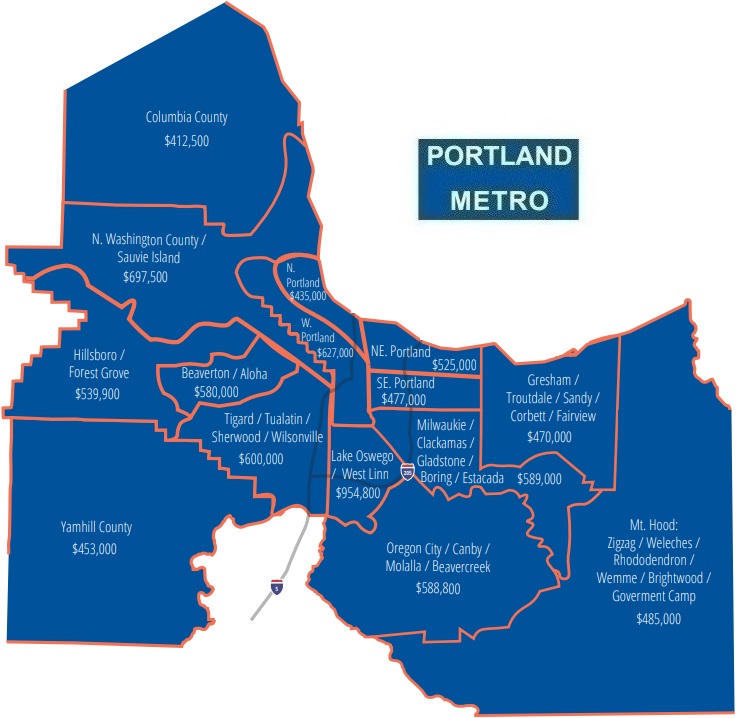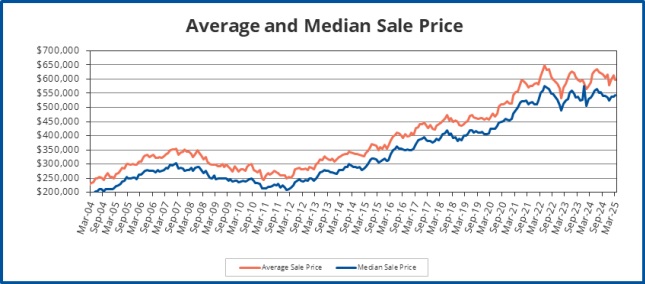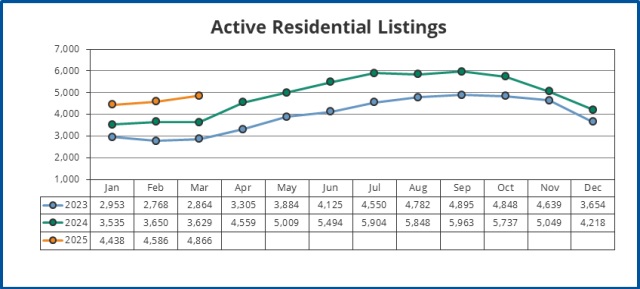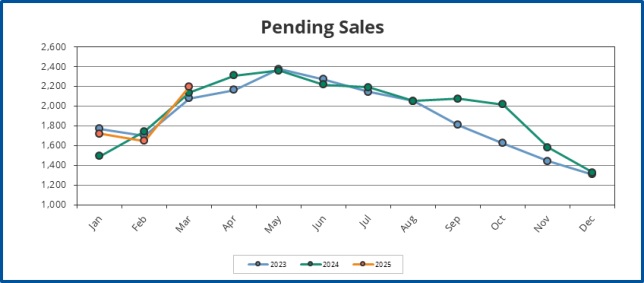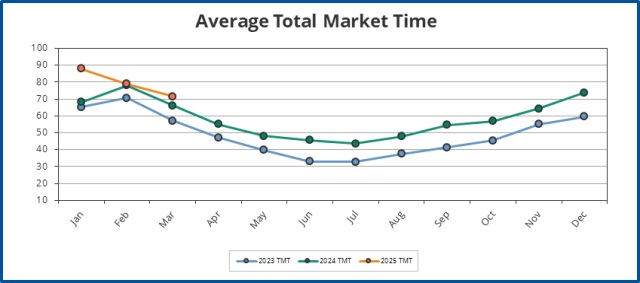
The average home price in the Portland Metro fell 2.5% in March while the median home price rose just under 1%. This means higher-end homes experienced the brunt of the drop, and homes closer to the median home price are still rising during the spring market. Inventory fell back to 3 months in March which indicates the Portland housing market is on the verge of shifting back to a seller’s market. Over the past month, many properties have sold faster and for more money than I had expected. I attributed this to middle-aged and older buyers snapping up houses since they have seen a longer track record of stable home prices during times of economic uncertainty. While open houses still had traffic last weekend, I suspect some buyers have pulled back either due to holding their down payment in a higher risk asset that has now fallen in value or through lower confidence in the U.S. economy in general. Throughout my career, every time buyers have pulled back has been a buying opportunity; whether it be from a Covid lockdown, wildfire smoke, or a stock market correction. Real estate tends to be a place of safety, the Great Recession from 2007-2009 excluded. The last material drop in U.S. home prices from a recession prior to that was in 1929-1932 during the Great Depression. The biggest misconception I see among my generation is they don’t understand this since the Great Recession was their first experience with a recession and they didn’t study economics. This causes most Millennials, and also Gen Z, to hesitate to buy. As a result, they eventually get left behind by rising home prices while waiting for a crash that never comes. Personally, if my wife and I hadn’t purchased homes immediately when the opportunity presented itself in 2019 and 2021, we wouldn’t own 2 homes and be eventually planning to buy a 3rd one. Real estate is a shield through exposure to inflation in a good way. The houses appreciate and we pay down our mortgages which more than offsets increases to our living expenses. While home ownership doesn’t fix the issue of a bigger grocery or electrical bill on a day to day basis, it does provide a way to benefit from inflation over time.
The 30 year fixed rate averaged 6.63% across the United States last week. Mortgage rates have been volatile with the 30 year landing closer to 6% last Friday and closer to 7% yesterday. I think some of the mortgage companies are intentionally charging higher origination fees right now to take advantage of the swings. There are now 3-4 rate cuts being priced in by the bond market by year’s end but it remains to be seen if that will actually occur. The Federal Reserve held rates steady at the conclusion of their meeting on March 19th. While the benchmark interest rate remained unchanged, the Fed Board of Governors decided to reduce quantitative tightening (QT) through the reduction in sales of treasury bills off their balance sheet from $25 billion to $5 billion per month. This should help slightly reduce short term interest rates. Unfortunately for home buyers, the Fed has indicated they will continue to sell $35 billion of mortgage backed securities (MBS) off their balance sheet every month for the foreseeable future. This should keep mortgage rates slightly elevated over where they would naturally land. Every one of the Fed Board of Governors are concerned about tariffs leading to an increase in inflation. Tariffs are fundamentally inflationary by nature since they usually move up the cost of goods in lockstep with the size of the tariff. The main source of misunderstanding is the producer doesn’t even pay the tariff, the entity importing the item does. This virtually guarantees the cost is passed 100% to the consumer like a tax. If the importer can’t make money, they simply won’t import the item in question. This is already starting to occur with companies like Nintendo and Jaguar Land Rover pausing imports late last week in response to a new wave of tariffs announced by the U.S. government on April 2nd. The promise of large tariffs on virtually every U.S. trading partner shocked world stock markets with the S&P 500 falling 9% over the next 2 trading days. On April 4th, China retaliated with 34% reciprocal tariffs which caused a large drop in global stock prices over the weekend. There is a lot of volatility. The S&P 500 was down another 5% in early trading on Monday before rumors of a pause on the U.S. tariffs flipped markets positive. When the news officially came out on Wednesday that most of the tariffs were being paused for 90 days, the S&P 500 rose 9.5% in a single day. I would expect more volatility to come as more policy changes occur.
The way the “tariffs” from other countries were calculated and shown to the American people last week was not based upon any known economic formula to analyze trade. The reality is the new U.S. tariffs were an escalation over the levels of tariffs the United States was previously subject to. That’s the reason why China retaliated and stock markets plunged. Last Friday Fed Chairman Jerome Powell indicated that the Federal Reserve would not immediately step in to help markets. The Fed’s hands are tied because the tariffs will have effects that would support conflicting policy stances. Higher unemployment would support Fed intervention, such as lowering interest rates. However, the Fed Board of Governors are most worried about persistent inflation, with Jerome Powell stating “all forecasters have tariff inflation affecting core PCE inflation, core CPI inflation this year without exception” at the conclusion of their last meeting. If the Federal Reserve prematurely lowers the benchmark interest rate, like it accidentally did from 1973-1975, it could help stoke a second wave of inflation and put the U.S. economy into stagflation like we saw in the 1970’s and early 1980’s. Stagflation is when economic growth is slow or contracting while at the same time, consumers are experiencing aggressive price increases of goods and services. When the Consumer Price Index (CPI) peaked during the first and second waves of inflation in 1974 and 1980 respectively, U.S. Gross Domestic Product (GDP) was also contracting. This means the U.S. economy was in a recession just as inflation was peaking both times. We haven’t seen anything like that in 45 years and I certainly wouldn’t want to. The worrying part of the Federal Reserve holding off any intervention using monetary policy is there is no immediate “Fed put” to stop the stock market from continuing to fall. Only Congress or the President have the ability to stabilize stock markets for the time being.
There are three directions the Federal Reserve could go as the year progresses. If the recent changes in consumption, employment, and overall sentiment are just a speed bump for the U.S. economy and not an actual recession, I would expect the Federal Reserve will follow through with 1-2 rate cuts in the 2nd half of the year. If the economy remains strong and inflation is not under control, the Federal Reserve will have to sit on their hands and do nothing. Their dual mandate of maintaining stable employment and stable prices won’t allow any rate cuts if the job market remains healthy and the rate of inflation stays over their 2% target. In the third scenario, the U.S. economy deteriorates further and that adds deflationary pressure to the U.S. dollar. Deflation occurs when the demand for goods and services falls as consumers keep more savings on hand rather than making discretionary purchases. A recession may result in U.S. producers cutting prices in certain areas due to reduced demand. This would counteract price increases from tariffs to some degree. Normally a recession would result in a lower value of the U.S. dollar making U.S. products cheaper for foreign consumers. This would ultimately boost exports and help the U.S. economy recover, at least in a free-trade environment. The tariffs on Europe and Asia have resulted in some retaliatory tariffs which could undermine demand for U.S. goods in foreign countries. This could counteract any increase in demand for U.S. exports as the U.S. dollar falls, which would mean the economy will have to rely on other areas outside of manufacturing to lead any recovery.
In the event of a recession, the Federal Reserve will be able to intervene by cutting the federal funds rate more aggressively. This could cause mortgage rates to plummet so real estate might be in a unique position to benefit as a real asset that has exposure to interest rates. With the federal funds rate currently at 4.25-4.5%, there is a lot of room to cut rates as long as the rate of inflation continues to fall. The Fed Board of Governors will likely watch the rate of inflation and health of the job market extremely closely over the next few months before making any new policy decisions. We could very well see another wave of inflation if the Federal government doesn’t reverse course. The only other recent time in history that the U.S. economy experienced back-to-back waves of inflation, the stock market was trapped in a trading range. The Dow Jones didn’t hit a new high from 1966 all the way until 1982. At the same time, the average U.S. home price increased 224% over those 16 years. In Portland, the average home price went up further, from $18,600 in 1966 to $73,500 in 1982, an increase of 295%. Since 2019 the average home price in the Portland Metro is only up 30% by comparison.