
In this fourth installment of the series about the changing landscape of real estate transactions, I am going to update you on what is happening in the Portland marketplace regarding real estate fees during the spring housing market. At this point, we have more information to share about the real time impacts to buyers and sellers as changes by the Department of Justice (DOJ) from August 2024 further play out. The objective of this piece is to summarize the changes that are reshaping how real estate transactions are negotiated, the impacts upon buyers and sellers 8 months into the changes, and how to best navigate buying or selling a home as a result. We have seen a substantial number of transactions and I will transparently break down how much buyer’s agent commission sellers have been agreeing to pay at the end of this write up.
Commission sharing started in the late 1800s. Real estate brokers would gather at the offices of their local associations to share properties they were trying to sell. They agreed to compensate other brokers who helped sell their properties and the first MLS was born. Commission sharing was based upon the idea that “if you help me sell my inventory, I’ll help you sell yours.” The National Association of Realtors (NAR) was founded in 1908. California was the first state to introduce real estate licensing in 1917 so there would be oversight in real estate transactions. Now every state has licensing and presently there are approximately 540 MLS across the county. Even though real estate transactions were regulated once real estate licensing was a requirement in each state, buyer agency in its current form didn’t exist until the early 1990’s. Prior to that, both real estate agents technically had agency relationships with the seller with one agent representing the buyer in spirit. This was changed by a spree of lawsuits in the late 1980’s which resulted in the creation of buyer agency. This allowed each side of a real estate transaction to have independent representation rather than the “buyer beware” mentality that had been instilled from legal judgements up to that point. Dual agency also exists. This is where one agent represents both the buyer and seller in a more neutral stance similar to how title companies help both sides during the transaction. However, the vast majority of transactions have one agent representing the buyer and a different agent representing the seller.
The initial catalyst for changes in the real estate industry happened back in 2019. The National Association of Realtors and a few brokerages were sued in a class action lawsuit by some home sellers in Missouri. The lawsuit was over the fact that listing agents played a role in determining buyer’s agent commissions. Up until August 12th, 2024 in Oregon, buyer’s agent commissions were advertised through the local MLS and paid by the seller almost 100% of the time. Up to that date, when a listing agent secured a listing, they determined along with the seller how much to offer the buyer’s agent as part of that process. While every listing contract used in Portland clearly defined a certain amount of buyer’s agent compensation, the presumption of the lawsuit was that total commission per transaction was being pushed higher since listing agents had a role in determining how much buyer’s agents were paid.
The Sitzer-Burnett Trial took place in October 2023. The NAR and brokerages lost by decision of a jury. In 2024, the Department of Justice became involved in negotiating the final terms of the settlement. The NAR subsequently settled in March 2024 and the settlement terms led to changes in how transactions are negotiated. Ironically, it appears the party that started the initial class action lawsuit had a conflict of interest. They introduced an artificial intelligence (AI) driven app that was supposed to replace buyer’s agents last year following the ruling, bringing into question whether the initial lawsuit that started the changes was intended to be in the best interests of consumers or not.
Realtors are not replaceable with AI in my opinion. My ability to spot problems with homes before they are inspected has played a crucial role in success so far in my career. The complexity but also psychology of such an emotional transaction doesn’t lend itself to a computer taking our place. I use psychology to help my clients gain insight into what the other side of the deal is thinking. This ability to intuitively know what buttons to push and when to push them to get an intended result, and what actions to sidestep that may cause offense, has been the key to getting 67% of the offers I have written in my career accepted. I have a 42% winning rate in bidding wars and have at this point negotiated around $1M in seller concessions as a buyer’s agent. My team has had $21,982,695 in closed sales in the last 12 months.
The settlement of the Sitzer-Burnett trial was finalized on November 26th, 2024. A result of the settlement is buyer’s representation agreements are now mandatory for the foreseeable future to tour any homes outside of open houses. At present, what I have been experiencing in terms of the amount of knowledge of the average consumer is they expect to have to sign a contract when selling their home. This is ingrained into the public conscience given the process of listing a home in the United States has been virtually the same for almost 140 years. Many consumers I encounter have heard of the changes to buyer’s agency. However, they do not fully comprehend the implications for them as consumers. Some home buyers come into the process having no idea anything has changed. This leads to some surprise when buyers want to look at homes, especially the first time. A buyer’s representation agreement is a contract between a buyer’s agent and home buyer that stipulates the agent’s responsibilities to the buyer, outlines how compensation will be paid and how much it will be. It isn’t legal to tour properties in the state of Oregon without a signed buyer broker agreement outside of walking through open houses. This means you are not able to call Zillow or Redfin to tour a property anymore unless you want to sign an agreement with the agent on the other end. You will have to interview and hire an agent as the first step in the home buying process.
A commission agreement also needs to be in place before an offer is submitted for the payment of the buyer’s agent commission (BAC) by the seller to be legally enforceable. Ultimately for a buyer’s agent to be able to negotiate their own commission to be paid by a seller, a buyer broker agreement must be in place before the offer is written. If the buyer has agreed that an agent should be compensated for their work, regardless of whether they or the seller are paying them, then the agent at that point can negotiate for their compensation to be paid by the seller while still looking out for their client’s best interests. The reasoning is the buyer would have to pay for representation out of pocket if the seller doesn’t agree to pay for it and therefore the agent is still acting in their client’s interests in asking for payment at closing as a seller concession.
Unfortunately, I have seen instances over time where certain buyers have been nervous to sign and this has caused them financial harm. Some unknowingly went into dual agency with a seller’s agent who wasn’t transparent while others failed to obtain a home at all. I’ve also seen instances where a buyer is locked in with an agent they want to fire because they signed a buyer’s representation agreement with a financial penalty to cancel written into the agreement. Our team does not leave any early cancellation penalties or non-performance penalties in the buyer’s representation agreements we sign with buyers. We make sure it is absolutely clear that we are not locking anyone into anything. After all, prior to the mandatory use of these agreements, we never used buyer’s representation agreements while some other teams did. We stand by the quality of our work and never have needed to lock anyone into working with us.
As a high performing team, we have seen more transactions than almost all of the realtors in our market since the changes took effect. This has given us unique insight into how much buyer’s agent commission sellers in our market have been agreeing to pay. From August 13, 2024 to present our team has put 27 sales into escrow. In 21 out of 27 escrows the sellers agreed to pay a 2.5% buyer’s agent commission during the upfront negotiation. In one escrow the seller paid 2.25%, one seller paid 2.17% (which amounted to $10,000 exactly) and in two other instances sellers offered 2%. I was in a bidding war in February where my buyer split the commission with the seller. They ultimately paid 1.25% but the offer price was only at asking when there were multiple offers. It was really just the equivalent of the buyer paying 1.25% over the asking price. I was in an off market deal that closed on April 18th. That deal had the buyer paying the commission entirely, while at $39,000 under the asking price.
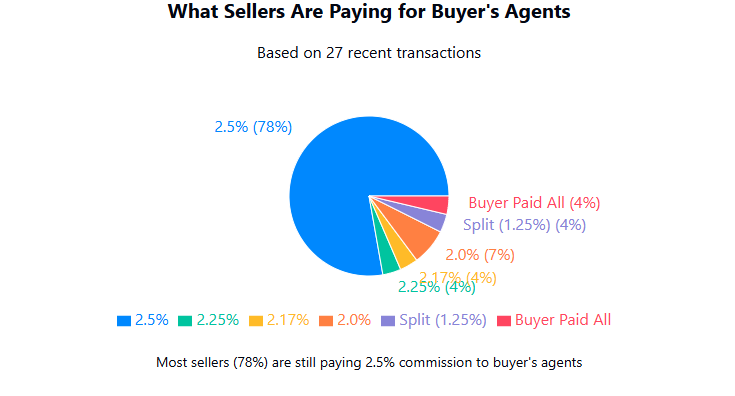
I also had a huge bidding war on a listing in March that resulted in similar numbers. 9 out of the 12 offers received asked the seller to pay 2.5% buyer’s agent commission. One buyer asked the seller to pay 2.25% while another was at 2.1%. There was one offer much lower than the rest with the buyer offering to cover the entire buyer’s agent commission. In each instance, the amount the seller is asked to cover relates to the sale price, how much in seller credits there are and if there are multiple offers, among other considerations. Sellers haven’t gotten away with paying less than 2% of the fee except in very rare circumstances, such as a bidding war, where really the sale price would just have gone higher prior to last August. That’s our takeaway so far. The buyer ends up in the same place they would have before the DOJ and court system became involved, only the structure of the sale is slightly different in some instances.
I wanted to be transparent for a few reasons. Some of you that have done business with me know I am honest by nature, even to a fault. I will always put my client’s interests first but I try to go further, always looking for problems before they happen and warning clients which potential pitfalls exist within each sale. It’s so important for the buyer and seller to have good representation in order to have a positive experience. Unfortunately, that isn’t always the case. In this changing environment, an increasing number of agents are not properly equipped to serve their clients to the best of their ability. This is because market dynamics are constantly changing, whether it be from changes to laws pertaining to the real estate industry or changes in economic conditions like we are currently experiencing. Also, some areas are doing better than others and market conditions can vary from place to place. One area and price point can consistently have multiple offers, such as starter homes in King City this month, while over in Reed’s Crossing so much inventory lends itself to buyer’s having more negotiating leverage there. You need an expert to know the difference and to be able to push for the best outcome the market will allow you in each situation. At Eden Homes NW, we are committed to excellence in every way we serve our clients and that will not change, regardless of what the future brings.