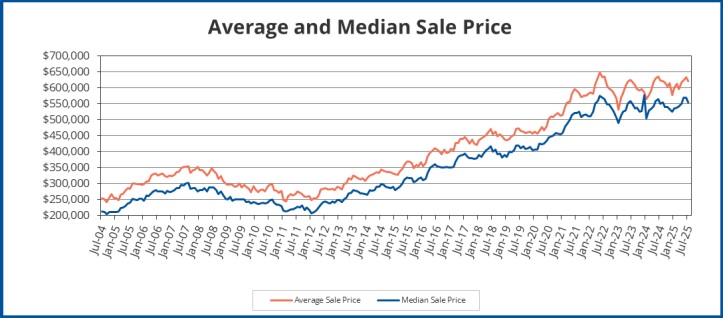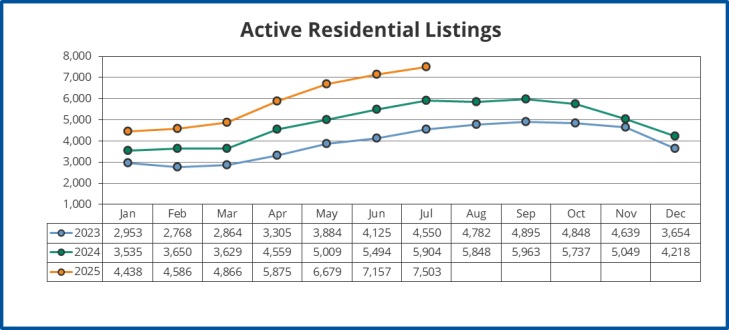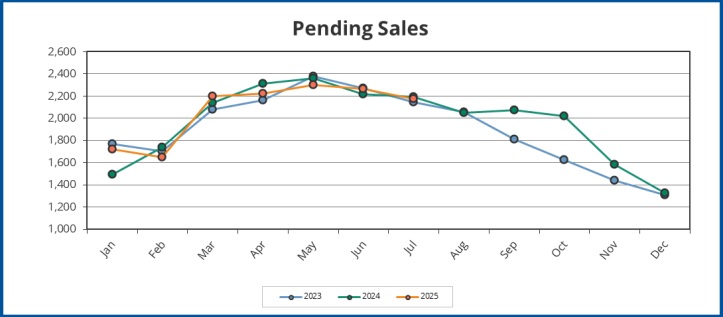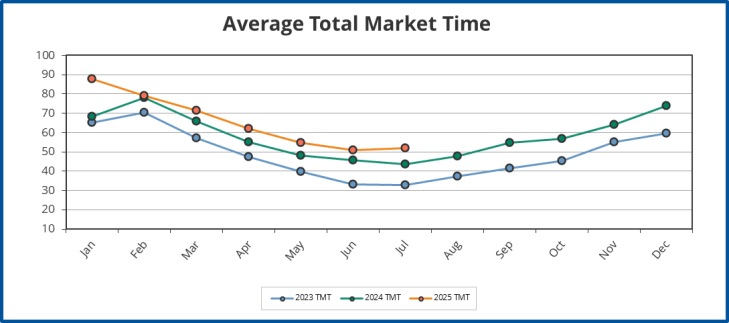
The average home price in the Portland Metro fell 2% in July. Portland home prices are still up almost 8% year to date. The inventory of listings rose slightly to 3.7 months from 3.6 months which indicates the Portland Metro is in a balanced market. Housing inventory is calculated by taking the number of active listings divided by the number of closed sales in the previous month. Less than 3 months of inventory is a seller’s market, where the Portland Metro was for over a decade leading up to this year. 3-6 months of inventory is a balanced market, where the Portland Metro has been this year, leading to more seller concessions on prices, repairs and credits in 2025 relative to 2014-2024. A buyer’s market is when there is over 6 months of inventory of listings. This is where buyers have the most negotiating power. While the average time on market for home sellers to secure a buyer in the Portland Metro is just over 50 days, some of the housing inventory is currently overpriced and sitting for several months. Every price point is different with entry level houses near $500,000 being the hottest part of the market. There are bidding wars occurring all over the city for entry level houses that are updated even as higher price points and other types of properties, such as condos, are taking longer to sell. The Portland condo market, which has fully detached from the market for houses and townhomes, tightened to 7 months of inventory with the median condo sale price rising 5% in July.
The northern Oregon coast has been in a buyer’s market for 8 of the last 10 months. Inventory on the coast rose to 7.4 months in July from 5.6 months in June. However, the highest number of coastal properties all year went pending in July so it looks highly likely the coast will be in a balanced market next month. A lack of realistic expectations from both sellers and buyers is starting to impact the market. Buyers and sellers are often not seeing eye to eye which is slowing the number of transactions. My inclination is that this market will tighten as mortgage rates continue to fall. The Portland Metro is only a 23% drop in inventory away from shifting back into a seller’s market. Economic news that continues to show weakening of the economy will play into the hands of home sellers in every U.S. market as mortgage rates are pushed lower. Similar to certain times in recent memory that the stock market has reacted positively to bad economic news due to the implications for the Federal Reserve lowering rates, I would argue bad news is good news for housing at the moment.
The 30 year fixed rate averaged 6.58% across the United States this week according to Freddie Mac. However, I have recently seen quotes as low as 6.125% on a Conventional 30 year fixed rate mortgage and 5.75% on a 30 year FHA mortgage. On August 1st, it was reported that the U.S. economy only added 73,000 jobs in July. This was well below most economist’s expectations with the market expecting 110,000 jobs prior to the release. Additionally, the Bureau of Labor Statistics also revised job growth in May and June from the initially reported job gains of 144,000 and 133,000 to show the U.S. economy only added 19,000 jobs in May and 14,000 jobs in June. Employment gains in May and June were 258,000 lower than previously reported, which the Bureau of Labor Statistics noted were “larger than normal” revisions. Downward revisions in job growth, along with newly announced tariffs the same day, contributed to a fall in the stock market, with the Nasdaq down 2.2% and the S&P 500 down 1.6% on that day. Bond yields fell as institutional investors shifted capital away from stocks into bonds, with the 10 year treasury yield dropping to 4.216%. This is what drove mortgage rates down in early August.
The same day the jobs report was released, the head of the Bureau of Labor Statistics was let go by the administration. The Bureau of Labor Statistics has lost a lot of employees this year, to the point where it was recently estimated that 30% of goods tracked by the Consumer Price Index (CPI) are guesses and not actual tracking of price changes. On August 12th, the most recent CPI report showed prices rose 2.7% over the last 12 months. This was the same level of inflation as June but still up from 2.4% in May. The CPI report showing prices remained stable strengthened speculation in the bond market for upcoming rate cuts by the Federal Reserve. This continued to add downward pressure on mortgage rates last week. All eyes will be on the next jobs report due on September 5th. We could see further weakness in the job market and this will likely force the hands of the Federal Reserve to cut rates as soon as mid-September. One day before the last jobs report, Fed Chairman Jerome Powell had stated the U.S. labor market was “solid.” Since then, speculation has increased that we will see a rate cut at the next Federal Reserve meeting on September 16-17. During the last Fed meeting, two of the Federal Reserve Governors publicly disagreed and signaled they wanted a rate cut while the rest wanted to hold rates steady. This was the most public display of disagreement within the Fed in more than 30 years. The last time two Fed Governors dissented a rate decision was in 1993.
The U.S. economy grew at a 3% annual pace in the second quarter so the United States was not in a recession over the first half of the year. However, the disappointing jobs numbers definitely put the risk of one occurring on more people’s radar. The S&P 500 and Nasdaq both hit fresh all-time highs last week; however, stocks probably do not belong near all-time highs given the kind of economic data we are seeing. I asked Financial Advisor Ashley Hedum with Northwestern Mutual about her approach given the current situation. She said “the goal is to diversify where assets are located and not just diversify from a stock market perspective. When it comes to investing, [each individual investor’s] time horizon is truly the most important factor. Based on the data and history of the stock market performance, we are certain that there will be volatility at times. We are also certain that each client should have an individualized strategy based on their goals. Real estate is a great option to look at as part of a diversified financial plan.”