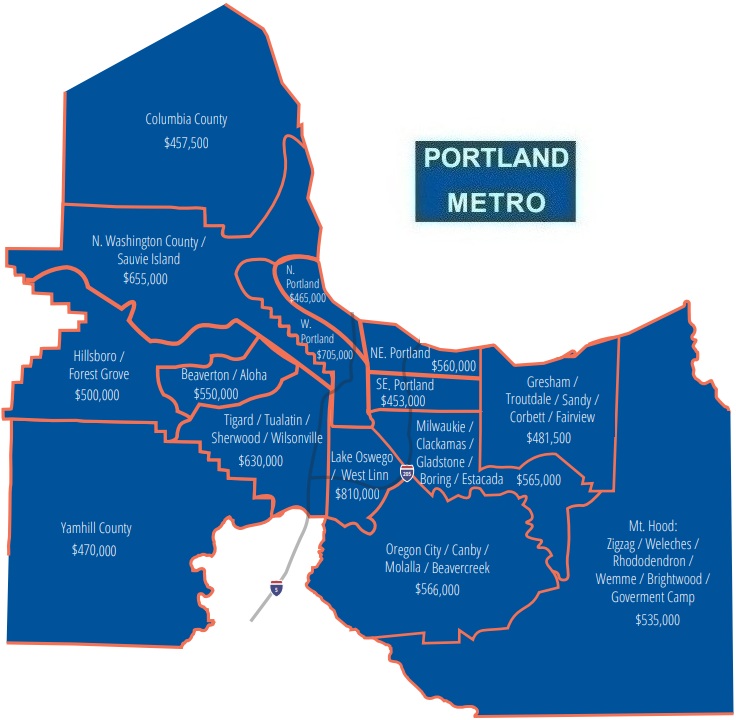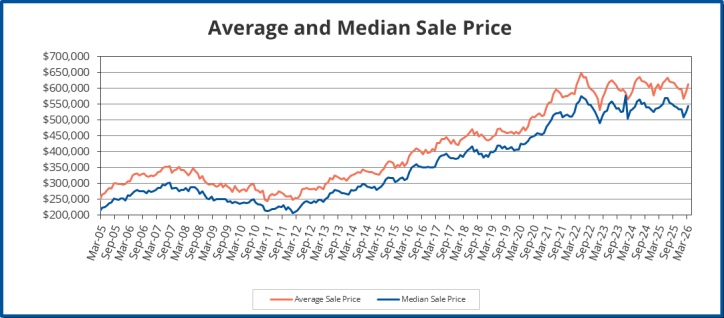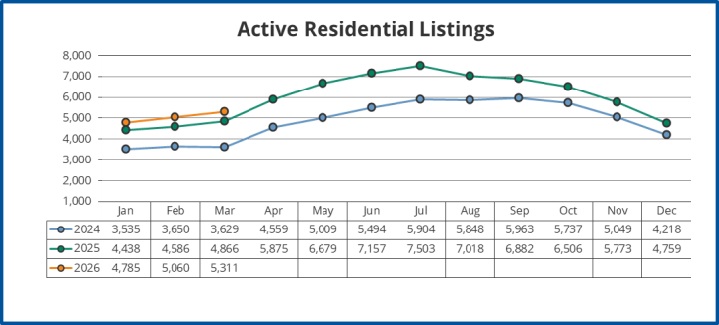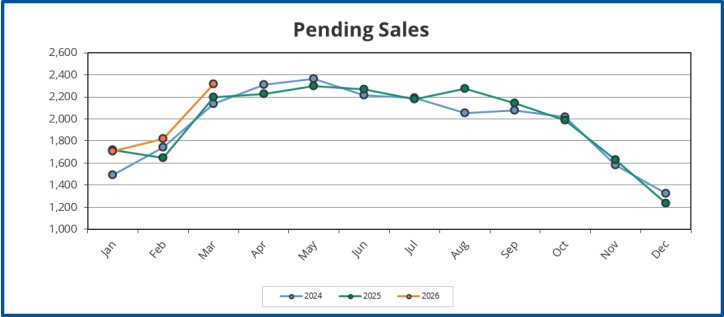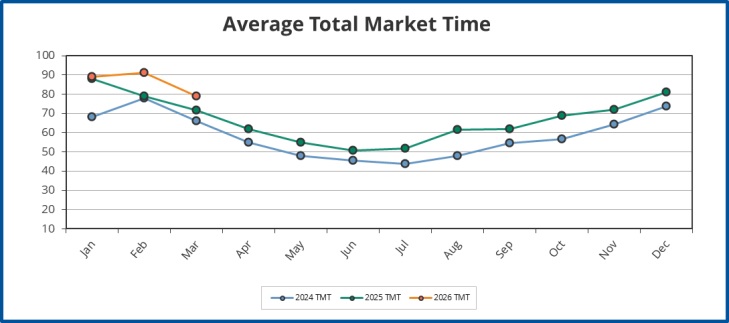
The average home price in the Portland Metro rose 4% in March. Home prices have now gained 8% in only 2 months following prices bottoming out in January. The seasonality in the Portland housing market is very strong with prices having risen 10% or more between January and July for 5 consecutive years. I expect this pattern will repeat again in 2026. However, one thing to keep in mind is these numbers lag what is happening in real time. Prices didn’t actually bottom in January, they bottomed in December and those sales closed in January. March prices continuing to rise is mostly a function of market activity in February prior to the conflict in Iran leading to an increase in mortgage rates. If I had to characterize the direct impact of the war on local real estate, activity levels dipped for around 30 days but have since recovered in April as we have seen similar activity levels to February. My team has closed two sales in April so far with 7 more sales currently in escrow. At the end of March, the inventory of homes in the Portland Metro dropped back to 3 months putting the housing market on the verge of shifting officially into a seller’s market. Mortgage rates are up from the start of the year but people still need housing and this is the most popular time of year to search for a home.
The 30 year fixed rate averaged 6.23% across the United States this week. We saw mortgage rates start to retrace from recent highs a couple weeks ago as some news out of the Middle East hinted that we could see an end to the Iran conflict. Bonds are trading in tandem with news on the war. This is because of the war’s impact on future inflation expectations. As Iran weaponizes access to oil through the Strait of Hormuz and now the U.S. military has subsequently imposed their own blockade, the price of oil has stayed elevated with Western Texas Intermediate (WTI) currently trading at $93/barrel. At the same time, in Qatar infrastructure at one of the largest natural gas fields in the world was damaged during the conflict. There could be a global supply shortage brewing in natural gas as well. In North America we are a net exporter of natural gas so a gas shortage would impact the global economy much more than the United States. What rising energy prices have done to the U.S. economy is bring more inflation back into the financial system. On April 10th, the Consumer Price Index (CPI) jumped 3.3% year over year. This was a big increase from the 2.4% rate of inflation reported the previous month. Accelerating inflation has changed the outlook of financial markets. As a result of higher inflation, no further rate cuts are expected by the Federal Reserve in the next 12 months.
I believe after the conflict ends we will see the rate of inflation decelerate for a time as energy bottlenecks are resolved. The global economy was in the process of slowing already before we saw this energy shock occur, and the United States is no exception. While the unemployment rate is still historically low at 4.3%, the labor market has been showing weakness for over a year. While a 178,000 job gain was reported in March, we have seen downward revisions and ultimately job losses in 4 of the last 8 months with revisions pending for January-March. If we continue to see job losses, I expect more rate cuts to go back on the table in an attempt to stop the U.S. economy from going into a recession. One thing that is apparent is the stock market and bond market have decoupled in how they are interpreting the same data. The bond market is showing signs of stress related to the slowing economy and rising inflation. This is known as stagflation. The stock market is not reflecting this with stock indexes close to all-time highs. While the war initially caused 10% or greater price corrections in the Nasdaq, Dow, and S&P 500, the S&P 500 and Nasdaq both hit new all-time highs on April 16th. I expect stocks to show much more weakness at some point in the next few years given we are late in the market cycle but the exact timing is uncertain.
A staggering amount of money has been pulled out of the stock market over the last 8 months to buy real estate directly with me. I have lost an exact count but money from the financial markets has fueled approximately $10M of just under $22M in sales over the last 8 months. I have never seen anything like it. Informed people are using real estate to diversify their exposure during these uncertain times. If we do see a recession, housing has a history of performing much better in recessions than the stock market. U.S. home prices have been stable or risen during 4 out of the last 6 recessions dating back to 1980. In contrast, during the last 6 recessions the S&P 500 fell 27% or more 4 times. From 1980-1982, when there were technically two back-to back recessions, the S&P 500 fell 27% while the median U.S. home price rose 13% from January 1980 to January 1983. When the Tech Bubble burst from 2000-2002, the S&P 500 fell 49% while the median U.S. home price rose 13% from January 2000 to January 2002. During the Great Recession from 2007 to 2009, the S&P 500 fell 56% while there was a 22% decline in U.S. home prices from 2007-2012 in the aftermath. Finally, there was a 33% stock drop from February-March 2020 during the Covid-19 Pandemic while the median U.S. home price rose 12% in 2020. So real estate is a much more defensive asset to own. Personally, I worry about my stock investments and not at all about my real estate holdings because of this.