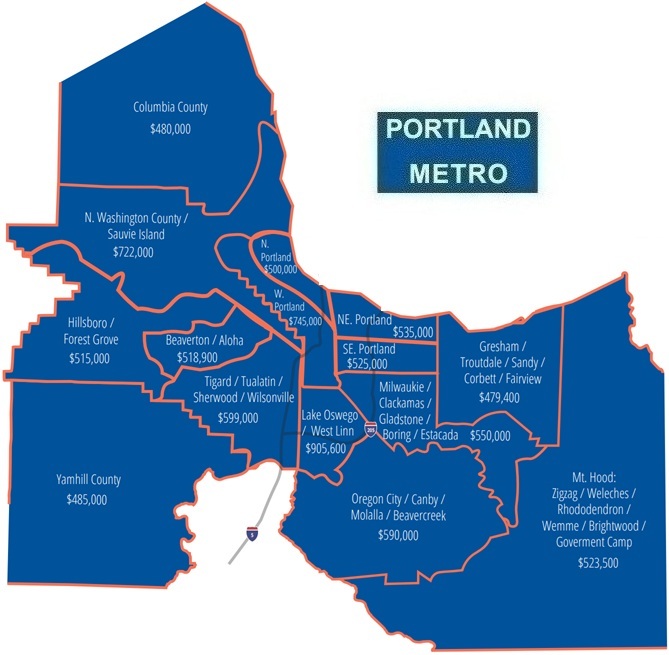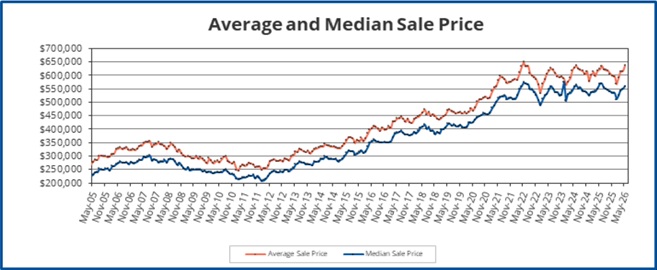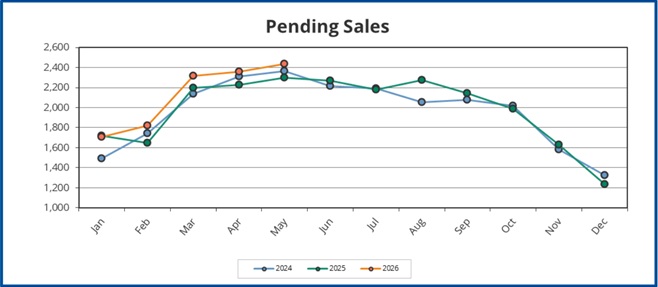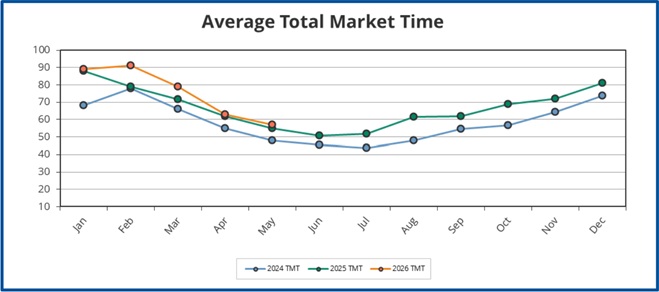
The average home price in the Portland Metro rose over 3% in May. This was a result of higher activity levels in April. There definitely has been an ebb and flow to this market. February was scorching hot; March was tepid during the peak of the Iran conflict, and April was active. We saw a slightly slower May relative to activity levels in 2020-2024 and now a resurgence of activity in June. It’s been interesting watching buyer behavior at different price points as mortgage rates remain elevated from the Iran conflict. There was a one day correction (10% drop) in semiconductor stocks on June 5th. Things were getting too heated in the stock market and tech stocks temporarily turned the opposite direction. You would think that would slow buying activity at upper price points of the housing market but that’s not the reality. Following the drop in stocks on June 5th, I was in a bidding war at the $2M price point in Lake Oswego on the morning of June 7th. On the other line, the team I was negotiating with was working on putting 7 different sales over $1M together at the same time. I then wrote an offer for another buyer on a house in the Portland Hills listed over $1M later that same day. The next morning, I wrote an offer at a more common price point – $450,000. Thankfully, I secured all three homes – despite two having multiple offers – and Marissa from my team sold another home the day after.
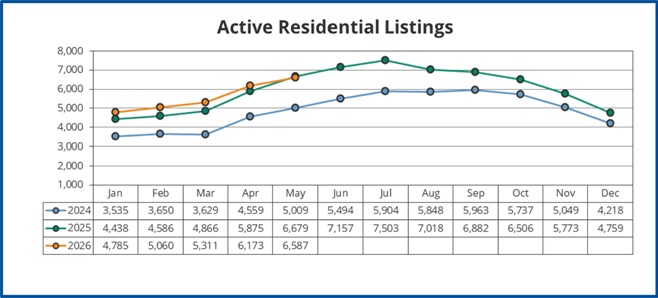
In Greater Portland, the inventory of listings hit 3.2 months in May, up from 3.1 months the prior month. The market is balanced with buyers having some negotiating leverage in most areas and price points. The market for condos in Greater Portland remains a buyer’s market with 6.5 months of inventory currently available. Effectively, there are twice as many sellers of condos relative to the number of buyers compared to the market for houses. The northern Oregon coast, defined as the area from Astoria down to Yachats, has 6.7 months of inventory. Greater Portland remains a much tighter market than the coast for the time being. With the Strait of Hormuz reopened pending a successful negotiation of final terms between the United States and Iran, it is possible we will see mortgage rates head downwards and this could tighten inventory levels all over Oregon. Mortgage rates remain elevated for the time being but we still continue to see a steady stream of sales going through on a monthly basis.
The 30 year fixed rate averaged 6.43% across the United States this week. On June 5th, it was reported the U.S. economy added 172,000 jobs in May, doubling forecasts by economists. The unemployment rate still sits at only 4.3%. While there are reasons to be a little skeptical of the strength of both numbers based upon reporting methods employed by the Department of Labor, the U.S. labor market does seem to be stable for the time being. In addition, the Bureau of Economic Analysis also reported the U.S. economy grew at a 2% annualized rate in the first quarter of the year. In tracking Gross Domestic Product (GDP), they also do a reading on inflation called the Price Index for GDP, which rose 3.6% in Q1. On June 10th, it was reported the Consumer Price Index (CPI) rose 4.2% in May on an annual basis. We have now seen the annual rate of inflation accelerate for 3 consecutive months according to that metric. The implication is that the bond market is now pricing in at least one rate hike by the Federal Reserve in 2026. Prior to the Iran conflict and ensuing spike in energy prices, the bias was towards the Fed doing additional rate cuts, not a rate hike, by year’s end.
At the conclusion of the most recent Federal Reserve meeting on June 17th, newly appointed Federal Reserve Chairman Kevin Warsh signaled some changes to how the Federal Reserve operates. The Fed will no longer be issuing a forward guidance on policy including future interest rate projections. There are multiple implications of this change. For one, investors may make more mistakes in anticipating future Fed policy changes which could lead to more volatility in the stock market. This will also affect strategy with mortgage rates around the times the eight Federal Reserve meetings occur every year. The bias should be towards locking mortgage rates before every Fed decision, if it wasn’t the case already. In providing less insight into what the Federal Reserve will do ahead of time, the real time impacts of Fed policy changes relating to rates or the Fed balance sheet will be more impactful as they surprise the market. Prior to 2008, the Federal Reserve didn’t use it’s balance sheet to influence the U.S. economy the way it has over the last 19 years. It has been speculated that the intention of removing the Fed’s forward guidance, along with potentially working more closely with the U.S. Treasury, is to lower the debt servicing costs of the U.S. government. That is necessary at this point given how high U.S. government debt has risen. The immediate reaction to the most recent meeting was an increase in yields on short term treasuries while pushing down interest rates on longer term bonds. Higher short term rates, while the energy shock from the Iran conflict subsides, will help lower long term inflation expectations. Ultimately, the intended impact of these policy changes appears to be an attempt to lower long term interest rates on U.S. government debt, which means lower mortgage rates could be on the way as time goes on.