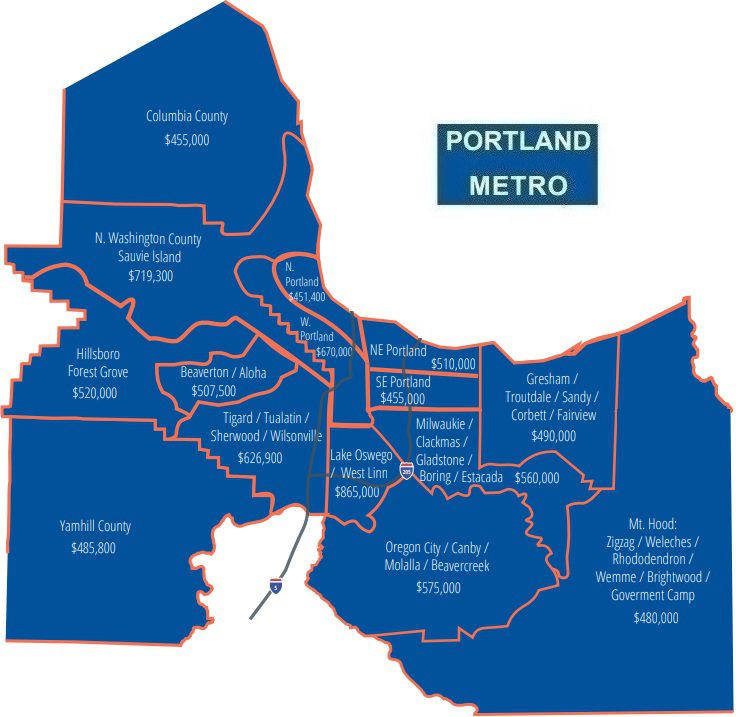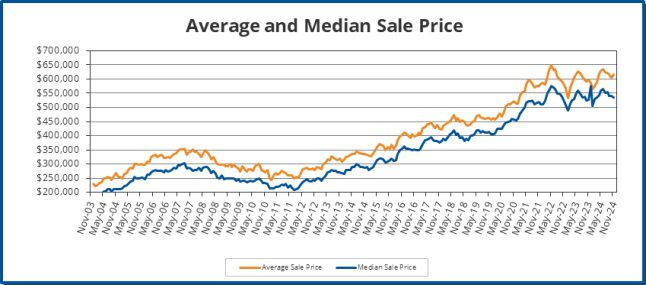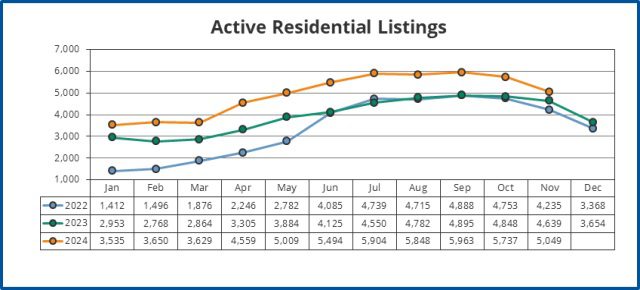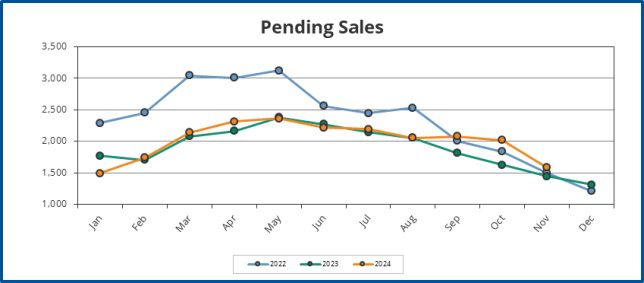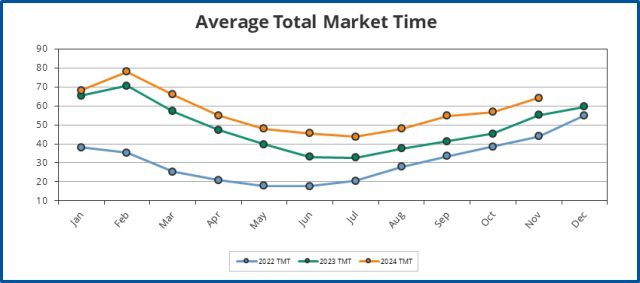
The average home price in the Portland Metro rose 2% in November. This was unexpected by most agents given the housing market was noticeably cooler heading into the election. More buyers started looking at homes in November. Open house traffic and the number of showings have definitely increased. However, the Portland housing market also shifted just barely into a balanced market again with inventory hitting 3 months. January is usually when a significant number of new buyers start looking at homes. However, my team was involved in a bidding war at Christmas last year so these things are hard to predict exactly. Mortgage rates were a major factor in the market starting to turn in late December last year rather than in January or February. Mortgage rates have been falling as we get further into December which is a good sign for housing market activity as the new year approaches.
The 30 year fixed rate averaged 6.6% across the United States this week. Mortgage rates and bond yields have been falling due to subpar economic data. The U.S. economy added 277,000 jobs in November, which was in line with expectations. However, the unemployment rate also increased to 4.2% due to more people searching for jobs and being unable to find employment. The Consumer Price Index (CPI) came in at 2.7% in November. The rate of inflation has been slowly inching up since hitting a low of 2.4% in September. Regardless, the bond market is betting heavily that the Federal Reserve is set to cut rates again at the conclusion of their meeting on December 18th. It is increasingly unclear whether the rate cuts the market is expecting in 2025 will come to fruition given the talk of 25% tariffs on Canada and Mexico being introduced as early as January. The fiscal policy of the Federal Government is not aligning with the monetary policy of the Federal Reserve in trying to slow the rate of price increases. However, even if tariffs lead to inflation in the short term, keeping rates higher for longer, that doesn’t mean a recession won’t cause interest rates to plummet in the medium term. The chances of a serious misstep in government policy have dramatically increased given there has been talk of interfering with the Federal Reserve. The Fed is fundamentally independent of the administration to prevent things like hyperinflation. A recent example was President Erdogan in Turkey trying to manage the Turkish Lira which resulted in a 51.97% inflation rate in August with Turkey presently in a recession. The United States could experience a deep recession in 2026 under certain scenarios. While this is my personal opinion, I know data scientists and economists that share this view. Uncertainty around policy may slow the Federal Reserve over the coming months but interest rates should still trend downwards over time.
The U.S. debt situation continues to worsen. Over $1 trillion was needed to service U.S. government debt in 2024. This means almost a quarter of government revenue just goes towards paying interest on debt rather than the debt itself. While government spending deficits have fallen from the record deficits in 2020-2021, the deficit was still well over $1 trillion in both 2022 and 2023. The U.S. government is expected to continue to run huge deficits under both parties going forward so this problem is not going away. The only way for U.S. government debt to drop in any meaningful way will be for the spending power of the U.S. dollar to fall. I’ll try to give a simplistic example of where this is heading. Let’s say the number of U.S. dollars doubled over the next 10 years. If the U.S. dollar was worth half as much, meaning a tank of gas cost $8/gallon and houses in Portland averaged closer to $1,100,000 vs what they cost presently, government tax revenue would increase dramatically as incomes would rise to partially offset this. Asset sales that incurred capital gains would also increase tax revenue. Outstanding U.S. government debt – just over $36 trillion at present – could ultimately be cut in half this way. This means it will be twice as easy to pay off this debt with twice the tax revenue to service it. What the government is doing is the equivalent of only paying interest on a credit card while continuing to run it up. Doubling the money supply would be the equivalent of doubling someone’s salary so they can make larger payments. That is probably where things are going in the long run.
Anyone close to retirement with funds parked in money market accounts that were earning 5.5-6% interest during the summer needs to find an exit strategy before interest rates fall further. Unlike mortgage rates, the interest rates in money market accounts and high yield savings accounts have moved downwards in lockstep with the Fed’s last 2 rate cuts. This means that an account with $450,000 that was earning 5.5-6% interest ($2062.5-$2250/month) during the summer is now returning 4.5-5% interest ($1688-$1875/month) after only 2 rate cuts. This will get worse with another rate cut coming mid-next week. Certain investment properties are attractively priced right now and can provide superior returns. There are townhomes that rent for $2500/month and cost around $450,000 with the cost of improvements. If you use a property manager, they will take 8-10% of the monthly rent so you would net $2250-$2300/month after management fees. On a townhome with no HOA fees, the net return would be roughly $1900/month after taxes, insurance and maintenance. This doesn’t take into account the income tax deductions for expenses paid for the investment property. You are also able to depreciate the asset against the rental income to further reduce the tax liability. In the end, you can incur substantially less taxes on rental income than from interest income.
Long term appreciation of the property itself is the cherry on top. The potential for a $450,000 townhome to be worth $550,000-$650,000 in 5-10 years is very good. Greater Portland is the 19th most undersupplied major city in the United States for housing out of 198 metros tracked by housing think tank Up For Growth. The most recent data indicates there is a shortage of over 45,000 units in Greater Portland with Oregon falling in the top ten most undersupplied states for housing. The same report also showed a shortfall of 3.85 million housing units nationwide. If you choose carefully, real estate investments can produce superior returns. However, the window to acquire a property with these kinds of margins will start to close in early 2025. First-time buyers will start targeting these same types of properties sometime in January, increasing competition and driving up prices. Home prices in the Portland Metro have risen over 10% from January through June for 4 consecutive years before seeing seasonal weakness in the fall and winter. October-January is usually the best time to buy real estate and I don’t see that changing anytime soon.