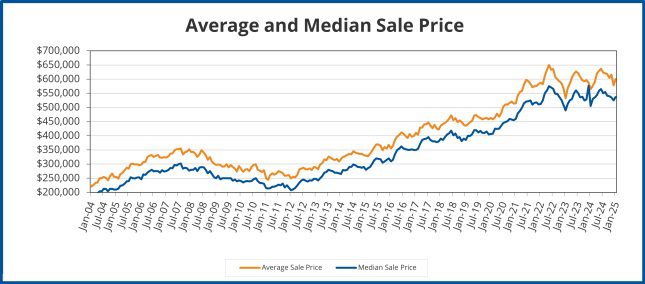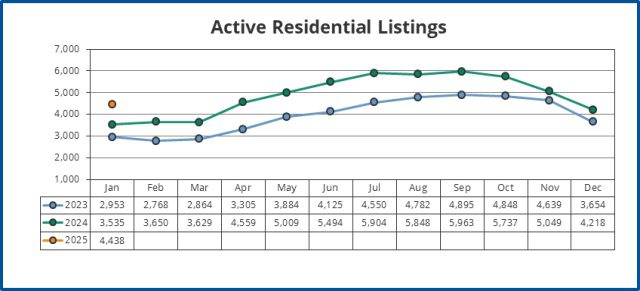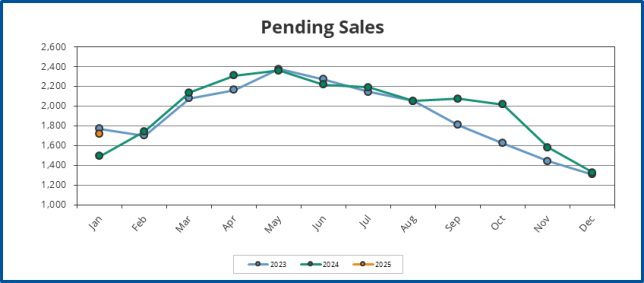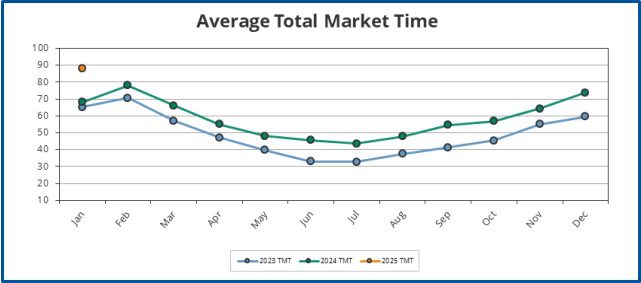
The average home price in the Portland Metro rose 4% in January while the median home price went up 2% relative to December. Home prices by both measures were also up over 6% year-over-year compared to January 2024. My team has put 8 deals into escrow since my last update so the market is definitely getting more active. Sellers appear to have increased negotiating power as market conditions improve relative to the more balanced conditions we experienced in the fall. That being said, the inventory of listings surprisingly went up to 3.7 months in January from 2.7 months in December. More than twice as many listings went on the market in January relative to December as sellers attempted to take advantage of a traditionally stronger time to sell. So technically the market swung back to a balanced market, which is defined as 3-6 months of inventory, even as the concessions buyers can secure in negotiations are smaller relative to the end of the year. I’ve never seen prices rise 4% with inventory going up 1 month in the same report before. Not even close. I think this contradiction was caused by listings being pulled off the market in November and put back on in January. As more inventory sells, prices will appreciate further as we go into the spring market.
Mortgage rates are gradually falling with the 30 year fixed rate averaging 6.87% this week. Rates potentially could drop more aggressively if we see continued stock market volatility or signs of economic weakness. While mortgage rates falling is positive for the housing sector, the reasons they are falling are negative for the U.S. economy as a whole. Only a week after I warned about stock market volatility in my last update we saw some on January 27th. Nvidia, which was the largest company in the world by market cap at the time, fell 17% in a single day. The $600 billion haircut was the largest single day drop of any stock in history. The cause was a Chinese artificial intelligence (AI) firm, known as DeepSeek, creating an AI bot that could compete with ChatGPT at only a fraction of the cost. Scale was supposed to be crucial in developing artificial intelligence. This allowed companies with closed-source technology to invest hundreds of billions of dollars with the idea they could charge a fee for the service they invested in. DeepSeek developed a free, open-source version for roughly $10 million dollars in a short period of time. They did this by allowing the AI bot to learn from existing AI instead of reading millions of books like had been done previously.
This was a huge shock to the largest U.S. companies with a lot of money already invested in the space. Alphabet (Google) dropped 4% by market close the same day. Microsoft fell 7.5% in value over the next 5 trading days given it’s substantial investment in OpenAI and ChatGPT. Google subsequently recovered then came out with bad 4th quarter earnings and fell 10% from Tuesday through Friday last week. The Magnificent Seven, which also includes Amazon, Apple, Meta (Facebook), and Tesla, have been carrying U.S. stock indices higher for the last two years. Their average return was 63% in 2024, comprising more than half of the gains of the entire U.S. stock market. Year to date, five out of the seven members of the Magnificent Seven are in negative territory with Meta and Amazon being the only strong performers. The concentration of returns among only seven companies poses risks to the broader market. The chances of a stock market correction have materially increased as some investors are now left wondering where the next shock to AI stocks will come from.
The U.S. economy grew at a 2.3% annualized pace in the 4th quarter. This level of Gross Domestic Product (GDP) growth was below expectations given the pace of growth was 3.1% the previous quarter. That report, along with the renewed Presidential promise to implement 25% tariffs on Canada and Mexico along with a 10% tariff on China, caused investors to sell stocks and buy safe haven assets at the end of January. It’s no coincidence the price of gold broke above $2900/ounce yesterday. The other area investors ran to was bonds. When institutional investors shift billions from stocks quickly into bonds in a flight to safety, the value of the underlying bonds rises, decreasing their yields. This in turn drives mortgage rates lower. If we see continued stock market volatility, it would actually be very supportive of home prices since lower mortgage rates increase housing affordability for the average consumer8