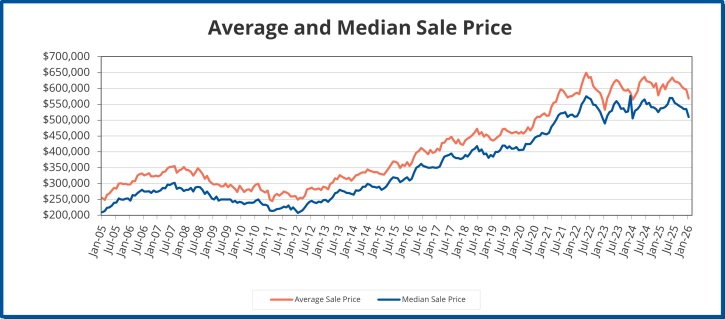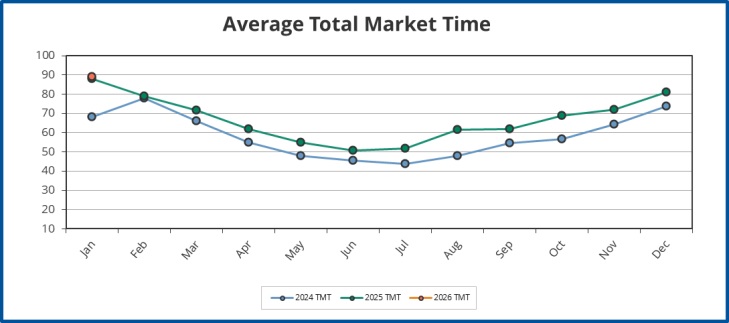
The average home price in the Portland Metro fell 4% in January. However, the sales that resulted in that drop were mostly negotiated around the holidays and are not necessarily indicative of the present market. On the ground, my team is seeing an uptick in activity as we get closer to the spring market. This typically happens every year. Our team closed 10 sales in January. Buyers have been very active with the 30 year fixed rate averaging 6.01% across the United States this week. Mortgage rates are being driven lower by the slow job market. On February 11th, it was reported that the U.S. economy added 130,000 jobs in January. While this showed a larger amount of job growth than in November and December combined, it will likely be revised downwards at a later date. The same report said the U.S. labor market only added 181,000 jobs in 2025. This was revised downwards from the 584,000 jobs the U.S. Bureau of Labor Statistics initially reported were added to the economy over the course of 2025.
When my last update came out, there were very unusual events unfolding with the U.S. dollar in real time. Extensive selling pressure on the U.S. dollar had pushed it down 4% in only 11 days as of January 27th. The price of gold went the opposite direction and jumped over $1000 to $5600 an ounce as money moved into gold as a risk hedge. On January 28th, the administration nominated Kevin Warsh as the next Chairman of the Federal Reserve which halted the fall in the U.S. dollar for the time being. Kevin Warsh is a very qualified economist who previously served on the Federal Reserve Board of Governors from 2006-2011. He is generally labeled as hawkish, or higher rate leaning in nature. His nomination resulted in a large correction in the price of gold from $5600 to $4600 per ounce in a matter of days. The U.S. dollar has since stabilized and is trading approximately 2% off its lows. To give you a sense of the size of these swings, the single day drop in the price of gold on January 29th exceeded the entire market cap of every cryptocurrency in the world. Speaking of which, Bitcoin has stopped behaving like a risk hedge with the price having fallen from an all-time high of $126,198 on October 6th to $66,728 as of February 18th.
The stock market did not escape the volatility we saw over the last few weeks either. On January 29th, Microsoft announced strong quarterly earnings of $38.3 billion which was a large beat over analyst expectations. However, there was concern among investors that Microsoft is spending too much on A.I. without a positive near-term return on that investment. Microsoft fell 12% in a single day after releasing earnings, which for a $4 trillion company amounted to a $350 billion reduction in their market cap. This also pulled down the Nasdaq which was down 2% over the next couple days. Stock market indexes have mostly been supported by the Magnificent Seven. Comprised of Apple, Amazon, Google, Microsoft, Nvidia, Meta (Facebook), and Tesla; the Magnificent Seven are all heavily investing into A.I. What the market reaction to Microsoft’s earnings signaled is that there could be less appetite for unfettered spending on A.I. going forward. The other side of the A.I. trade is that certain sectors of the stock market are plunging in reaction to speculation that A.I. could undermine their business models. First it was the service stocks that fell, then the wealth managers, then the insurance companies and finally the commercial real estate stocks were hit. Many of these companies are down anywhere from 10-20% in the last month. A significant amount of money is rotating into value stocks. Institutional investors are moving money into companies with strong profits, such as commodity producers, given rising metal prices.
The U.S. dollar and gold are telling an interesting story about future inflation. It’s becoming apparent that a 2nd wave of inflation will eventually hit the United States as foreign central banks continue to diversify away from the U.S. dollar. This might be the real reason we are seeing volatility in a lot of different areas of the financial markets. Real assets behaved incredibly well the last time we experienced multiple waves of inflation from 1964-1982. Gold and housing both qualify as real assets. Real estate could be a place to seek shelter and preserve spending power over time. I’ve seen more cash going into housing from high net worth families and people high up inside the banking industry than ever before since October. The new Fed Chair, while hawkish historically in nature, represents just one vote of the twelve Federal Reserve Board of Governors. We could see anywhere from 1-6 rate cuts over 2026-2027 depending on how things play out with the economy. When mortgage rates potentially start to rise again in 2027 or 2028, some of the inflationary pressure driving rates higher will likely come from higher home prices.