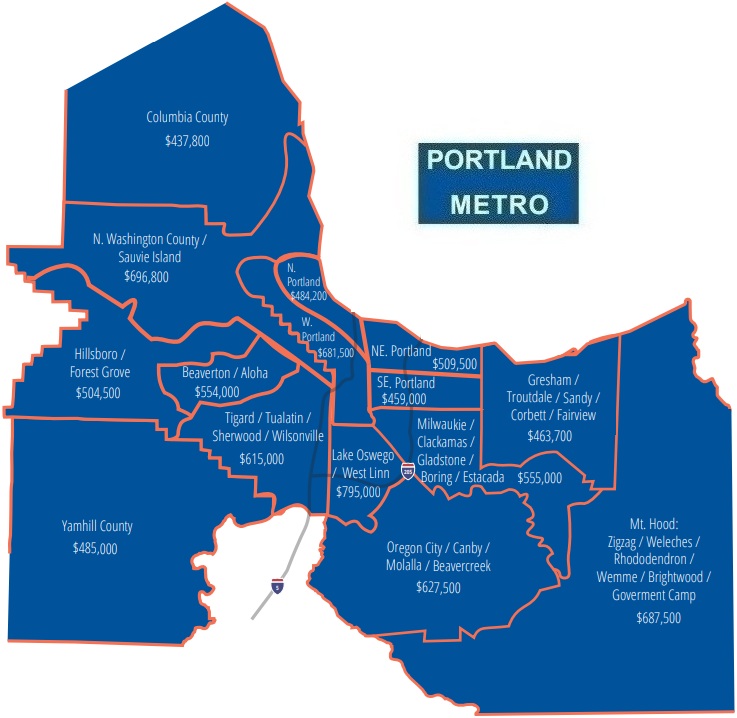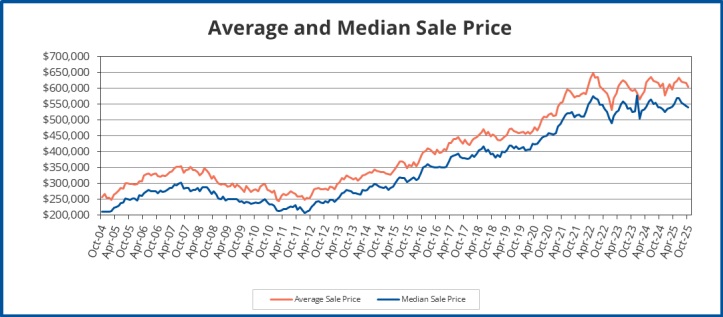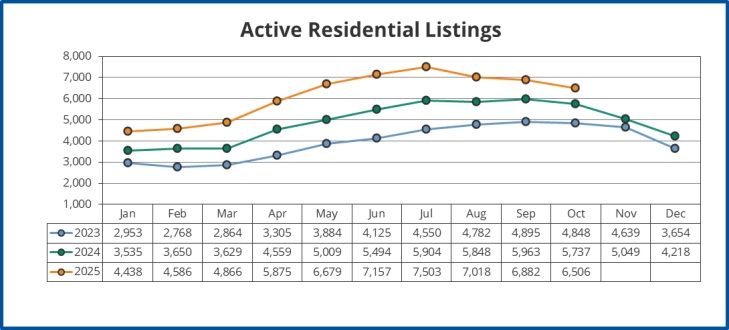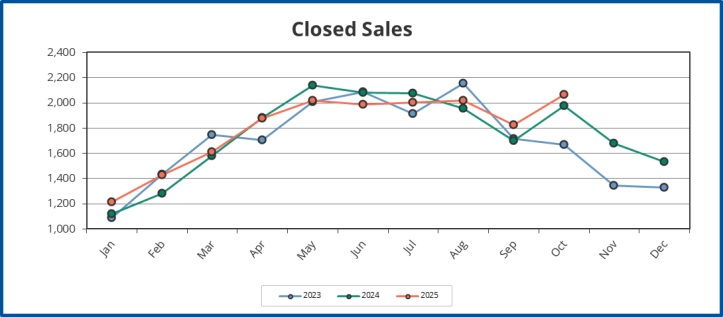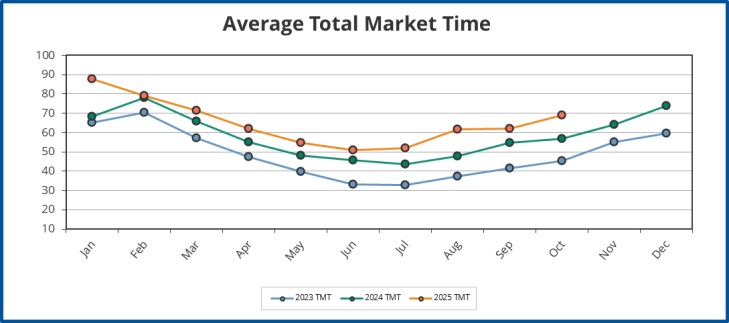
The average home price in the Portland Metro fell 2% in October. Home prices are still up 5% year to date. The inventory of listings plunged from 3.8 months in September to 3.1 months in October. This was due to the number of closed sales increasing approximately 15% month over month. My team closed 8 sales in October so this matches what we have been seeing on the ground. While there are still lots of listings to choose from, the housing market appears to be tightening in response to falling mortgage rates. This didn’t translate into stable prices like we saw in August and September, but it bodes well for home prices next year if this level of activity is sustained.
The 30 year fixed rate averaged 6.24% across the United States this week after gradually falling every week in October. It was interesting watching mortgage rates trickle downwards while the federal government was shutdown. Typically interest rates rise when there is any turmoil in Washington because it hurts bond investors’ perception of the safety of buying U.S. debt. Investors speculate a default is more likely and they want to be paid more interest to offset that risk. In September 2023, even the threat of a government shutdown pushed the 30 year fixed rate up near 8%, the highest it had been in decades. This time around we saw mortgage rates fall during a much worse scenario – a record long federal government shutdown – signaling we are in a different environment than the previous three years.
The Federal Reserve has tried to keep mortgage rates higher over the last three years. The reason is likely two fold. The Fed Board of Governors don’t usually keep mortgages on their balance sheet and the desire to remove them has influenced their policy decisions. The Fed removes mortgages from their balance sheet via a process called quantitative tightening (QT), which entails the Federal Reserve artificially increasing the supply of mortgages. Currently the Federal Reserve allows $35 billion of mortgages to roll off its balance sheet every month compared to only $5 billion in treasuries. This pushes the interest rates for newly issued mortgages higher than they would be in a free-trading market. As I had predicted in my last update, the Federal Reserve recently announced they will stop this practice by year’s end (on December 1st to be exact). So that reason for elevated mortgage rates will be gone shortly. This should hopefully push the 30 year fixed rate under 6% as soon as a few weeks from now, which has bullish implications for the housing market as a whole. The other reason is that much of the inflation in the economy from 2020-2023 was due to rising housing costs. The Fed has been consciously trying to hold the housing market back to slow the rate of inflation. It hasn’t worked in the sense that the median U.S. home price has only fallen 7% since mortgage rates doubled in the first half of 2022. The average home price in the Portland Metro is also 7% off record highs and came within 2.5% of record prices this June.
On October 29th, the Federal Reserve reduced the benchmark interest rate by 0.25%. While there is no guarantee of another rate cut in 2025, signs of continued weakness in the labor market will likely push the Federal Reserve Board of Governors to lower rates again during their next meeting from December 17-18th. On October 31st, the Fed quietly injected $30 billion of liquidity into the banking sector to support regional banks under stress. This is the second time in the last few weeks that the Federal Reserve had to intervene behind the scenes in the banking system. Current financial conditions are too tight for the financial system to function properly which means we should see a further loosening of monetary policy as time goes on. Mortgage rates are falling but still remain elevated compared to where borrowing costs are in the bond market. The biggest influence on mortgage rates is the 10 year treasury yield, which is sitting at 4.14%, (2.1% lower than the 30 year mortgage rate). Historically, the spread has been smaller, with the 30 year mortgage rate being 1.76% higher than the 10 year treasury yield on average since it started being tracked in 1971. What that means is that without bond yields falling at all, the 30 year fixed mortgage rate could drop another 0.34% or more as conditions normalize.