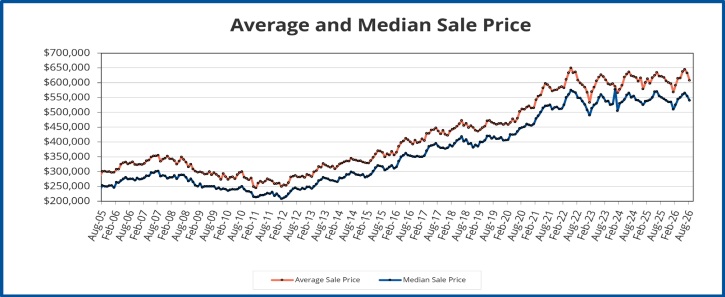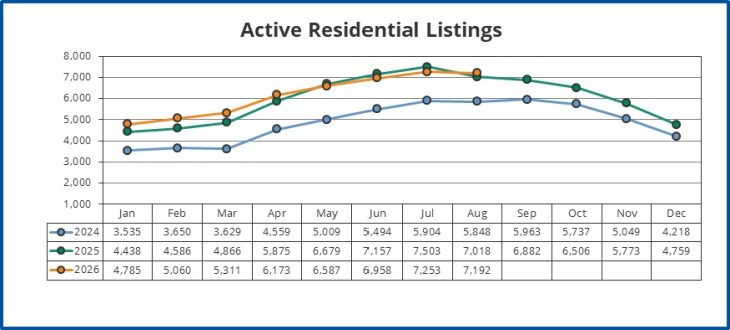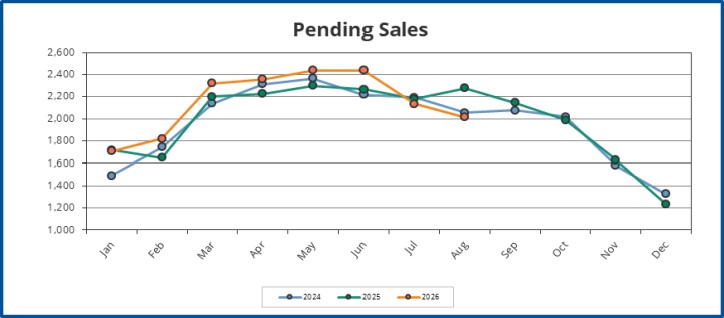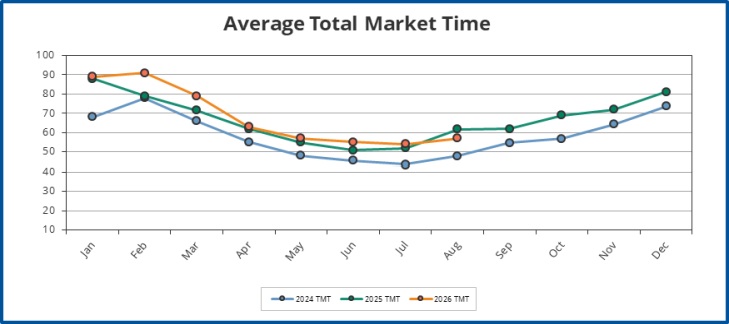
The median home price in the Portland Metro fell almost 3% in August relative to July. The market has slightly softened with the weather deteriorating along with a resumption of the school year taking some buyers out of the market. Arguably the best months to buy are coming up as seasonal weakness pushes home prices lower from October-December. The average home price has risen between 8-14% from January through July the last 5 years so it’s highly likely that the market tightens again in early 2027. The most consistently active month for the housing market in each of the last two years has been February. It’s surprising given March, April or May would be the months most people would expect to be the most active during the spring housing market. Either way, the market is functioning as expected. Well-priced, updated, houses are selling fairly quickly. The listings that sit are either not updated, overpriced, or both. The market for townhomes, and especially condos, is much weaker. Condo inventory remains near 7 months, indicating a buyer’s market. The overall Portland housing market is currently balanced with 3.8 months of inventory.
The 30 year fixed rate averaged 6.95% across the United States last week. During his annual speech at Jackson Hole, Federal Reserve Chairman Kevin Warsh stated that “inflation is running above our 2 percent target so the Fed’s predominant focus right now should be on prices.” The Federal Reserve subsequently followed through with a 0.25% rate increase at the conclusion of their last meeting on September 16th. However, the role of the Fed in determining bond yields, and the mortgage rates that track them, has been smaller recently as financial markets pay more attention to the operations of the U.S. Treasury. Treasury Secretary Scott Bessent has been trying to push long-term interest rates lower to help reduce the borrowing costs for the United States government.
The U.S government is currently printing money to buy-back long-dated U.S. government debt. On August 19th, the Treasury doubled the buy-back of U.S. treasuries from $2 billion to $4 billion per week. On September 9th, it was announced the operation for that week would be up to $6 billion. However, the same day the $5.2 billion buy-back in U.S. treasuries occurred, the bond market rejected the attempt and pushed mortgage rates dramatically higher. This was several days before the Federal Reserve took any action on rates. The reason bond yields and mortgage rates rose before the Fed increased the benchmark lending rate relates to the credit worthiness of the U.S. government. Currently the United States pays $3 billion per day in interest on over $40 trillion in debt outstanding. While the U.S. Treasury has some firepower to try to manipulate interest rates, the market will have the final say. Scott Bessent went as far as saying “I am the house now” on September 8th before the bond market gave him a rude awakening. However, the Treasury Secretary was likely talking about the U.S. government’s role in stabilizing the Japanese yen when he made that statement. Either way it clearly wasn’t well received by the market.
In 2022 due to a very slow Japanese economy, interest rates on Japanese debt were close to 0%. U.S. hedge funds realized they could borrow yen while paying almost no interest and then buy things like U.S. government debt. The difference in the interest rates would be pure profit. Known as the “yen carry trade,” borrowing money in Japan and investing it in the United States worked very well from 2022-2024, even as the yields on Japanese government 30 year bonds went from 0.7% to 2.3% by the end of 2024. 30 year U.S. treasury yields rose from 1.92% to 4.78% over the same time period so there was still a large premium remaining in U.S. interest rates by the end of 2024. However, from 2025 through mid-2026 the yen carry trade has become less profitable with yields continuously rising on Japanese debt. At some stage, hedge funds started redirecting borrowed Japanese money into the U.S. stock market. It’s estimated that approximately $2.35 trillion U.S. dollars is now in the yen carry trade and most of this is rumored to be concentrated in tech stocks.
If the yen appreciates too much against the U.S. dollar, it would lead to losses on the carry trade and the exodus of $2 trillion from the U.S. financial system. Even though it’s not in the interests of tech investors, at the direction of Scott Bessent the U.S. Treasury teamed up with the Japanese government in late July and potentially again in early-mid September to try to support the value of the yen. The Japanese currency rose 5% in late July and 6% in the first half of September against the U.S. dollar while these respective market operations were ongoing. The reason the U.S. government would be interested in doing this is Japan holds the most U.S. government debt of any foreign nation. Japan’s liquidation of U.S. debt to fund interventions in their own currency would push up U.S. interest rates and Scott Bessent’s primary goal is to keep rates down. The 30 year mortgage rate tracks 30 year treasury yields so everything Scott Bessent is doing to try to protect the U.S. government supports housing as well. If $2 trillion does head back to Japan based on a reversal in the exchange rate or the two countries’ interest rates converging further, the outgoing money will primarily hit the stock market.